Nähe
(Concept product case study)
Designing a path from acquaintances to people you can rely on
Product design case study exploring how migrants can move from first contact to deeper, more reliable relationships. Focused on reducing social pressure, enabling repeated meetings, and supporting trust in small fixed groups.
Hypotheses
Initial question
At the start, I observed that many migrants were not socially isolated, yet still lacked a close, reliable relationship in their new country.
What I did not yet understand was why those social contacts so rarely developed into something closer, or where in that process the real barrier was.
No clear starting point
Many migrants might not know where or how to begin building new friendships.
Existing tools fall short
Tools might not help migrants find people with whom relationships grow.
Migrants might not know how to maintain contact after a first meeting.
Lack of energy
Exhaustion, or language barriers might make building new relationships harder.
Desk research
Understanding friendship after migration
I reviewed studies and public discussions on how migrants build social relationships in a new country, then conducted 5 interviewss and a 49 survey with immigrant participants to explore the issue further.
Felt lonely or lacked social connection several times a month.
The issue was not a complete lack of contact, but the difficulty of turning existing connections into deeper relationships.
Interview
What migrants told me
I met people through tandem and dance groups. They're my hobbies, not my friends. Building deeper connections required meeting outside the activities and spending more personal time together.
Group activities can start a connection, but friendships grow outside them.
Close friendships grow when people feel safe enough to open up and be vulnerable.
I have people to play football with, yet no one to call when things get difficult. Close friendships develop when people feel safe enough to be vulnerable, share their worries, and open up.
I am connected to many people, but they did not become close friendships. Relationships grow when people meet several times, share real experiences, and gradually build trust.
Trust grows through repeated interactions and shared experiences.
Synthesis
What the stories had in common
People were meeting others, but many connections stayed within the activity or faded after the first meeting.
Contact without closeness
Being part of a group did not create a sense of belonging.
Friendly interactions often stayed at the surface.
Having people around did not mean having support.
No clear path after first contact
Connections often stayed tied to where they started.
The next step after a good first meeting felt unclear.
Existing tools offered little support for continuing the connection.
Closeness needed the right conditions
Seeing the same people repeatedly created familiarity.
Shared experiences helped relationships become personal.
Opening up required enough safety and time.
Everyday barriers broke continuity
Work and exhaustion left little energy for relationships.
Language barriers made social situations feel less secure.
Time, cost, and distance made meeting regularly harder.
Persona
Meet Sepideh
Sepideh is 38 and has lived in Berlin for five years. She has built a stable career and a life she is proud of, but even after all this time, the city still does not fully feel like home.

Sepideh is not alone. She goes to classes, joins groups, and attends events. Sometimes, good conversations happen. But when the situation ends, the connection often ends with it.
After a good conversation, she picks up her phone:
Should I message, or wait? What if I seem intrusive? That hesitation keeps her from taking the next step.

Connections often ended when the shared activity ended.
Being the one to initiate the next step felt socially risky.
Time, language, energy, and distance made regular meetings difficult.
A clear, low-pressure way to meet the same people again.
Continuity that did not depend on one person repeatedly reaching out.
A group formed around conditions that made repetition realistic.
How might we help Sepideh experience the path to building friendships in a new country from acquaintances to close relationships in a way that feels more natural and less burdensome?
Product strategy
Four principles behind Nähe
Design for continuity, not discovery
The same small group meets repeatedly over a defined period.
→ Nähe is built around repeated contact. It protects the possibility of meeting the same people again.
Remove individual selection and visible rejection
People join a group formed by the system; they do not choose one another.
→ This keeps the experience away from dating-app logic and reduces comparison, bias, and visible rejection. Everyone enters the group on equal terms.
Provide structure without controlling the outcome
The app makes the meetup path clear while keeping participation flexible.
→ The product can reduce uncertainty around meeting again, but it cannot decide whether friendship has formed. Its role is to support continuity and safety, then step back.
Form groups for feasibility, not compatibility
Groups are formed around what makes repeated meetings realistically possible.
→ Nähe uses only what is needed to make a group workable, then gives the relationship room to develop through repeated meetings.
Shared context and intent
Members share the experience of migration and a need for deeper connection.
The feasibility condition
Shared city, language, and time availability make repeated meetings realistic.
Lo-Fi
Turning the product model into a testable flow
I translated the four principles into a rough end-to-end flow to test whether users understood the fixed-group model and could successfully reach the group channel.


The welcome screen explains the fixed-group model, while onboarding collects the practical details needed to form the group.
The flow takes users from waiting for their group to seeing that it is ready and understanding how the repeated meetups will work.


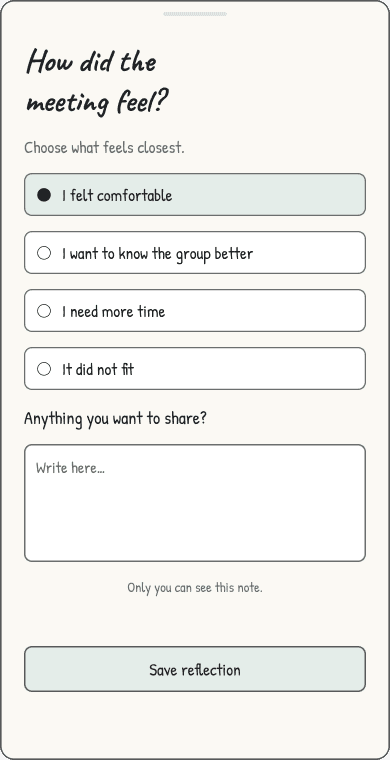


Private feedback supports safety, while the group channel keeps the connection open between meetings.
Usability testing
Testing whether the product model was understood
I tested the Lo-Fi prototype with two migrants, The remote sessions used a clickable prototype and a think-aloud approach.
Scenario
You have lived in Germany for some time, but many everyday connections fade quickly. Looking for more lasting relationships, you discover Nähe. Explore the app as you normally would.
Tasks
Explain your first impression
Continue through the flow
Reach the group and first meetup information
Explain how the model works
The test evaluated
Whether users understood the core model: small fixed groups, repeated meetups, and no individual selection?
Whether they could reach the first meetup information and the group channel without assistance?
Iteration
Refining the experience through usability findings
Because Nähe cannot promise or measure friendship, I defined success around the conditions the product can actually influence: understanding, activation, and repeated participation.
Users interpreted “Comfort level” as a score, they assumed the group or its members were being evaluated or matched.
I removed “Comfort level” and all references to group fit, scoring, or compatibility.
I removed the word “Locked,” highlighted only the next meetup, and Clafirid that users can skip one meeting and return to the next.
Users read “Locked” meetups as exclusion They thought missing one meetup could prevent them from joining the next one.
Users did not understand that no one was individually selected, they continued looking for control over choosing or rejecting specific people.
I clarified the group model on the “Your group is ready” screen, so users understand how the group is formed and what information is shown before joining.
Because Nähe cannot promise or measure friendship, I defined success around the conditions the product can actually influence: understanding, activation, and repeated participation.
Model comprehension
Can users explain that Nähe uses a fixed small group, repeated meetups, and no individual selection?
→ Measured through a comprehension check during think-aloud usability testing.
Activation to the first meetup
Can users move from onboarding to the first-meetup information without help?
→ Measured through task success, observed hesitation, and drop-off across the flow.
Repeated participation
Do members return for at least four of the six planned meetups?
→ This would be measured as a cohort metric in a future live pilot, not in the prototype.
Existing tools support different stages: discovering events, meeting new people, practising a language, or staying in touch. Few are designed to support what happens after the first contact.
Meetup · Bumble For Friends · Timeleft · Tandem
Nähe focuses on continuity: the same people, repeated meetups, less social friction, and no individual selection or ranking.
Universities . International employers . Migrant onboarding programs
These organizations already support migrant integration and social connection. Because migrants may also face exclusion, social pressure, and financial barriers, partner funding could keep access free or affordable while preserving a low-pressure, trust-based experience.
Redesign
Refining the flow through usability findings
I resolved the key issues in the flow and then developed the final UI with a calm visual language, clear hierarchy, and consistent components. The interface reflects Nähe’s principles of continuity, flexibility, and low-pressure participation.